Oct 10, 2026
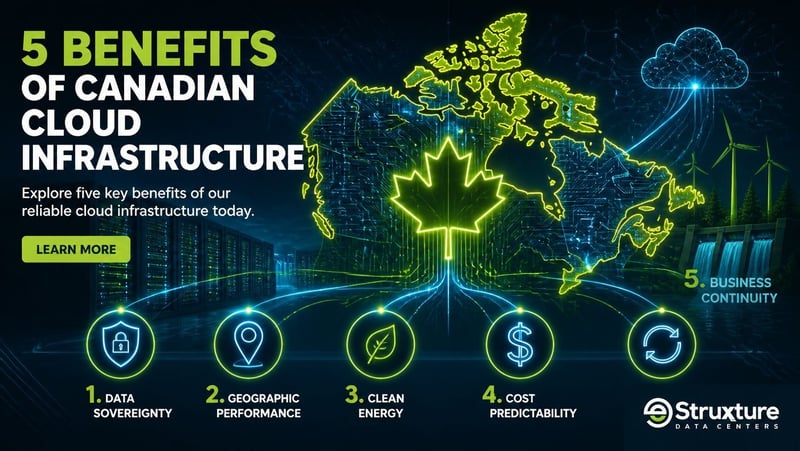
When enterprise leaders evaluate where to host their mission-critical applications and data, the decision often comes down to more than technical specifications. Geography and jurisdiction matter, and increasingly, businesses are discovering that cloud infrastructure in Canada offers distinct advantages that foreign alternatives simply cannot match.
The conversation around data hosting has shifted dramatically over the past few years. What once focused purely on uptime and bandwidth now encompasses data sovereignty, regulatory compliance, environmental responsibility, and strategic business continuity. For organizations operating in or serving Canadian markets, these considerations aren't just nice-to-haves; they're fundamental to long-term operational resilience and competitive positioning.
Whether you're exploring Canadian enterprise colocation options or evaluating your current infrastructure strategy, understanding the unique benefits of Canadian cloud infrastructure can inform smarter decisions about where your data lives and how it's protected.
1. Data Sovereignty Protects Your Business from Foreign Legal Reach
Data sovereignty represents one of the most compelling reasons to choose cloud infrastructure in Canada rather than hosting critical workloads in foreign jurisdictions. This principle ensures that your information remains governed exclusively by Canadian laws and protected from foreign government overreach. A distinction that carries significant weight in today's geopolitical climate.
Canadian data sovereignty gives organizations clear legal control by keeping their information under Canadian privacy standards and judicial oversight. Supported by a robust framework that includes PIPEDA and provincial legislation, data stored in Canada benefits from stronger protections than those found in many other jurisdictions. When disputes arise, or regulatory questions emerge, authority remains with Canadian courts, ensuring predictable legal recourse, transparent regulatory processes, and protection from foreign surveillance programs that operate outside Canadian democratic oversight.
For enterprises in regulated sectors like healthcare, finance, and government services, data sovereignty isn't optional; it's a compliance requirement. Even for organizations without explicit regulatory mandates, maintaining sovereignty over business-critical data reduces legal risk and demonstrates a commitment to customer privacy.
2. Superior Performance Through Geographic Proximity
Physical distance matters in digital infrastructure. When your data sits closer to the people and systems accessing it, performance improves measurably. Cloud infrastructure in Canada delivers lower latency, faster response times, and better user experiences for Canadian operations. Advantages that translate directly into productivity gains and customer satisfaction.
Latency (the time it takes for data to travel between source and destination) increases with distance, and even small delays can accumulate across thousands of daily transactions, degrading application performance and user experience.
Canadian cloud infrastructure eliminates these geographic penalties for Canadian users. When your Toronto office accesses data from a Montreal facility rather than a Virginia data center, the reduction in network hops and physical distance creates measurably faster performance. This proximity advantage becomes even more pronounced for organizations with distributed operations across multiple Canadian cities. A Vancouver team accessing applications hosted in Calgary experiences dramatically better performance than connecting to distant international facilities. Beyond simple speed, lower latency enables advanced applications such as real-time analytics, collaborative tools, and interactive customer experiences that depend on rapid data exchange.
For enterprises operating across Canada's vast geography, strategically distributed cloud infrastructure creates redundancy while maintaining performance. eStruxture's pan-Canadian presence across Montreal, Toronto, Calgary, and Vancouver allows organizations to position workloads close to regional user bases while maintaining interconnected infrastructure for business continuity. This distributed approach combines local performance with national reach, a balance that serves Canadian businesses better than centralized foreign alternatives.
3. Environmental Sustainability Through Clean Canadian Energy
Sustainability has become an operational consideration for modern digital infrastructure, particularly as data centers form the backbone of cloud services, digital platforms, and enterprise systems. Because these facilities require reliable, continuous power to operate at scale, the source of that electricity plays a decisive role in determining the environmental impact of cloud infrastructure. In this context, cloud infrastructure in Canada offers a distinct advantage: access to some of the world’s cleanest electricity grids.
Canada generates over eighty percent of its electricity from low-emission sources, with hydroelectric power dominating in Quebec and British Columbia. This clean energy foundation means that data centers operating in these provinces run on renewable electricity without requiring premium pricing or complex power purchase agreements. The environmental benefit comes standard, not as an expensive add-on.
For organizations with sustainability commitments, carbon reduction targets, or ESG reporting requirements, the source of electricity behind your infrastructure is a measurable part of your footprint. Many Canadian data center regions benefit from low-emission grids — especially where hydropower is a primary generation source — reducing the carbon intensity of day-to-day operations relative to fossil-heavy markets. Rather than relying on offsets alone, enterprises can make progress by selecting facilities with a verifiable low-emission power profile and clear reporting.
Canadian data centers also benefit from natural cooling techniques enabled by the country’s climate, reducing reliance on energy-intensive mechanical systems while lowering operational costs.
As regulatory pressure around corporate climate responsibility intensifies, the energy profile of your digital infrastructure will face increasing scrutiny. Customers, investors, and regulators are asking harder questions about supply chain emissions, including the carbon footprint of cloud services. Choosing cloud infrastructure Canada powers with clean energy provides a defensible answer to those questions while supporting genuine progress toward climate goals.
4. Cost Predictability and Currency Stability
Financial planning requires predictability. When infrastructure costs fluctuate with exchange rates, international pricing structures, and cross-border transaction fees, budgeting becomes complicated and risk increases. Cloud infrastructure in Canada offers cost stability that simplifies financial management and protects against currency volatility.
For Canadian organizations paying for foreign cloud services, exchange rate fluctuations create unpredictable cost variations. Currency fluctuations can cause infrastructure expenses to increase even when consumption remains constant. This currency risk introduces volatility into operational budgets and complicates long-term financial planning. Over multi-year contracts, exchange rate swings can significantly impact total cost of ownership.
Canadian cloud providers eliminate this currency exposure by pricing services in Canadian dollars, keeping costs stable regardless of forex market movements. That predictability supports more accurate budgeting and clearer ROI calculations while reducing overall financial risk, which is an especially meaningful advantage for organizations operating with tight margins or fixed budgets. Beyond currency considerations, Canadian cloud infrastructure can also reduce data transfer costs by minimizing cross-border movement and avoiding unexpected egress fees.
The economic advantage extends to procurement and contracting. Working with Canadian providers means dealing with familiar business practices, Canadian contract law, and local support teams operating in your time zone. This reduces friction in vendor relationships, simplifies dispute resolution, and ensures that support resources understand the Canadian business context. When issues arise — and in complex infrastructure environments, they inevitably do — having providers who operate under Canadian jurisdiction and business norms makes resolution faster and more predictable.
5. Enhanced Business Continuity and Disaster Recovery
Business continuity planning requires infrastructure that remains accessible and operational regardless of external circumstances. Cloud infrastructure in Canada offers resilience advantages that some foreign alternatives cannot guarantee, particularly when geopolitical tensions, trade disputes, or cross-border complications threaten access to critical systems.
International relationships can shift rapidly, and infrastructure that depends on cross-border data flows introduces risks beyond an organization’s control. Canadian cloud infrastructure helps insulate operations from these external disruptions.
The resilience advantage becomes particularly important for disaster recovery planning. Effective DR strategies require geographically distributed infrastructure that remains accessible during regional disruptions. Canada's vast geography allows for true geographic diversity while maintaining single-jurisdiction simplicity. You can replicate data between Montreal and Vancouver — separated by over four thousand kilometers — while keeping everything under Canadian legal and operational control.
This distributed Canadian approach provides better disaster recovery than relying on foreign facilities that may become inaccessible during international incidents. If geopolitical tensions restrict cross-border data flows, organizations dependent on foreign infrastructure face potential service disruptions. Canadian cloud infrastructure eliminates this risk by keeping all components within national boundaries while still providing the geographic separation necessary for effective disaster recovery.
For organizations in critical sectors such as healthcare, finance, government services, and utilities, maintaining operational continuity isn't just good practice; it's a regulatory requirement. Canadian cloud infrastructure supports these mandates by providing resilient, accessible, legally compliant hosting that remains under Canadian control regardless of international circumstances. This sovereignty over your disaster recovery infrastructure ensures that business continuity plans remain viable even when external factors disrupt international relationships.
Making the Strategic Choice for Canadian Operations
The decision about where to host your infrastructure carries implications that extend far beyond technical specifications. Cloud infrastructure in Canada offers a combination of legal protection, performance optimization, environmental responsibility, financial predictability, and operational resilience that foreign alternatives cannot match for Canadian operations.
As organizations increasingly recognize data as strategic infrastructure, the jurisdiction governing that data becomes a competitive differentiator, shaping decisions around privacy, compliance, and operational control.
For enterprises evaluating their infrastructure strategy, the question isn't whether Canadian cloud infrastructure offers advantages, as the evidence clearly demonstrates it does. The question is whether your current hosting arrangements align with your organization's strategic priorities around data sovereignty, performance, sustainability, and business continuity. If they don't, exploring Canadian colocation and connectivity services represents a strategic investment in infrastructure that serves your business interests rather than exposing them to unnecessary risk.