Oct 9, 2026
Choosing where to house critical IT infrastructure is one of the most important decisions a business can make. The wrong choice can lead to vendor lock-in, limited bandwidth options, and costly network constraints that only surface after workloads are live.
That is where carrier-neutral data centers come in. These facilities give organizations the freedom to select from multiple network providers, cloud platforms, and connectivity partners without being tied to a single telecommunications company.
We will break down what carrier-neutral means, explain the key terms every IT leader should know, and show how this model supports modern hybrid cloud strategies.
What Is a Carrier-Neutral Data Center?
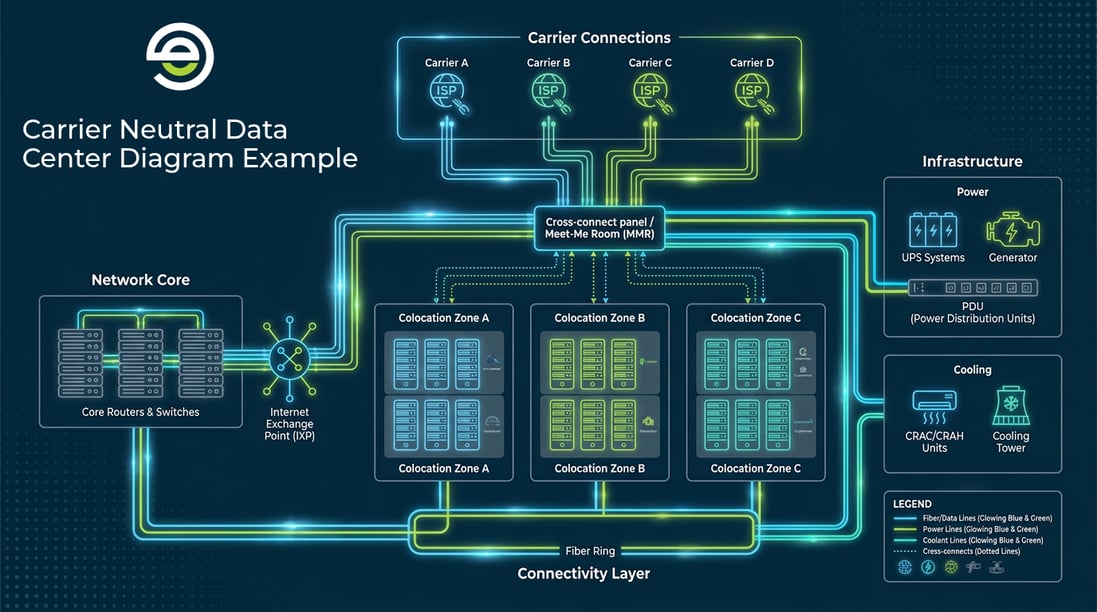
A carrier-neutral data center is a colocation facility that operates independently from any single telecommunications provider or internet service provider (ISP). Instead of bundling connectivity into the colocation contract, these facilities invite multiple competing carriers into the building.
This creates a marketplace of connectivity options under one roof. Businesses renting space in these facilities can choose network providers based on their specific requirements for bandwidth, latency, routing, and pricing.
According to Mordor Intelligence's 2026 Data Center Market Report, financial institutions and enterprises are increasingly choosing carrier-neutral colocation connected to multiple cloud on-ramps. The report projects the global data center market will grow from USD 425.3 billion in 2026 to USD 684.39 billion by 2031, driven largely by hybrid cloud strategies and interconnection demand.
How Carrier-Neutral Data Centers Differ From Carrier-Specific Facilities
In a carrier-specific data center, the facility is owned or operated by a particular telecom company. Customers must use that provider's network services, which limits flexibility and can create long-term cost and performance constraints.
Carrier-neutral facilities separate the real estate (space, power, cooling) from the network services. This separation is what enables real provider choice and positions carrier neutrality as both a connectivity advantage and a risk management decision.
Key Terms in Carrier-Neutral Data Centers
Understanding carrier-neutral data centers requires familiarity with several technical concepts. Here are the terms that matter most.
Meet-Me-Room (MMR)
-
A meet-me room is a secure, shared area inside a data center where different carriers, ISPs, and customers terminate their fiber and network equipment. Think of it as the interconnection hub where networks literally meet each other.
-
This centralized location enables direct connectivity between parties without routing traffic through the public internet. Meet-me rooms are essential infrastructure in any carrier-neutral facility.
Cross-Connect
- A cross-connect is a dedicated physical connection, usually fiber or copper cabling, between two parties inside the data center. For example, a cross-connect might link a customer's server rack to a carrier port in the meet-me room.
- Cross-connects enable private, low-latency links that bypass public internet routing.
Network Diversity
- Network diversity means connecting to multiple independent carriers and fiber routes rather than relying on a single network path. This approach reduces dependency on any single provider and improves resilience against outages, cable cuts, or carrier failures.
- Carrier-neutral facilities are specifically designed to promote network diversity. Businesses can establish connections with several carriers using different physical paths and entry points into the building.
Peering
- Peering is an arrangement where two networks agree to exchange traffic directly, usually without transit fees, over a dedicated connection. This commonly happens in carrier-neutral data centers through private peering via cross-connects or through Internet Exchange Points (IXPs) located in the facility.
- Carrier-neutral centers serve as prime locations for peering because they host ISPs, cloud providers, content delivery networks, and enterprises in the same building.
Benefits of Carrier-Neutral Data Centers
Organizations that choose carrier-neutral facilities gain several strategic advantages. These environments allow businesses to select from multiple telecommunications providers within a single facility, reducing dependence on any one carrier and creating room to negotiate better rates and terms.
This multi-carrier structure also improves reliability, since traffic can reroute through alternate providers if one experiences an outage, helping organizations maintain uptime and minimize disruption. Some other advantages include:
Freedom of Choice and Competitive Pricing
When multiple carriers compete for business inside the same facility, customers benefit from better pricing, improved service level agreements, and more bandwidth options. There is no contractual requirement to use a specific carrier, which preserves negotiating leverage over time.
Improved Redundancy and Uptime
Connecting to multiple carriers with diverse network paths creates built-in redundancy. If one provider experiences an outage, traffic can fail over to another. This architecture supports high availability requirements and Tier III or Tier IV data center designs.
Lower Latency and Better Performance
Direct connections between enterprises, cloud platforms, and networks in the same building reduce latency compared to routing through the public internet. For latency-sensitive applications like financial trading, real-time analytics, or video streaming, this performance advantage is significant.
Support for Hybrid and Multi-Cloud Architectures
Modern IT strategies often involve workloads spread across on-premises infrastructure, private clouds, and multiple public cloud providers. Carrier-neutral facilities make it easier to interconnect with AWS, Azure, Google Cloud, and other platforms through direct cloud on-ramps.
How Cloud Connect Fits Into Carrier-Neutral Facilities
Cloud Connect services take carrier neutrality a step further by providing dedicated, private pathways between colocation environments and major cloud providers.
Instead of routing cloud traffic over the public internet, Cloud Connect creates secure connections with consistent low latency. This approach enhances security, improves performance, and delivers predictable costs compared to variable internet bandwidth charges.
A robust cloud connectivity solution typically offers:
- Direct access to hyperscale clouds including AWS Direct Connect, Microsoft Azure ExpressRoute, and Google Cloud Interconnect
- Near-instant provisioning once the initial port is activated
- Flexible bandwidth options from 50 Mbps to 100 Gbps depending on requirements
- Short-term contracts that allow connections to be spun up for days or weeks rather than years
For organizations running hybrid cloud architectures, combining carrier-neutral colocation with cloud connect services provides the flexibility to scale workloads across environments while maintaining control over network performance and costs.
Choosing the Right Carrier-Neutral Provider
Not all carrier-neutral facilities offer the same level of connectivity options or operational quality. Here are the key factors to evaluate:
Number of On-Net Carriers
A facility with only two carriers technically qualifies as neutral, but it does not provide a robust marketplace. Look for data centers that host dozens of local, national, and international providers.
Direct Cloud Access
Verify that the facility offers direct, private connectivity to major public cloud providers. This capability is essential for hybrid cloud strategies and reduces reliance on public internet routing.
Cross-Connect Pricing and Policies
Investigate the monthly recurring costs for physical cross-connects. Some facilities offer low space rental rates but charge high fees for the cables required to reach carriers. Transparent pricing and flexible policies matter.
Geographic Coverage and Redundancy
For organizations with distributed operations, consider providers with multiple facilities across different regions. This enables geographic redundancy and supports disaster recovery strategies.
Sustainability and Compliance
Many enterprises now require data center partners that operate with renewable energy and maintain compliance certifications. Verify that facilities meet relevant sustainability & green energy standards for your industry.
Take the Next Step
Carrier-neutral data centers provide the connectivity freedom, redundancy, and performance that modern enterprises need. Combined with cloud connect services, this infrastructure model supports hybrid cloud strategies while reducing vendor lock-in and network risk.
Contact us today to learn how eStruxture's carrier-neutral facilities and cloud connectivity solutions can support your business requirements.